
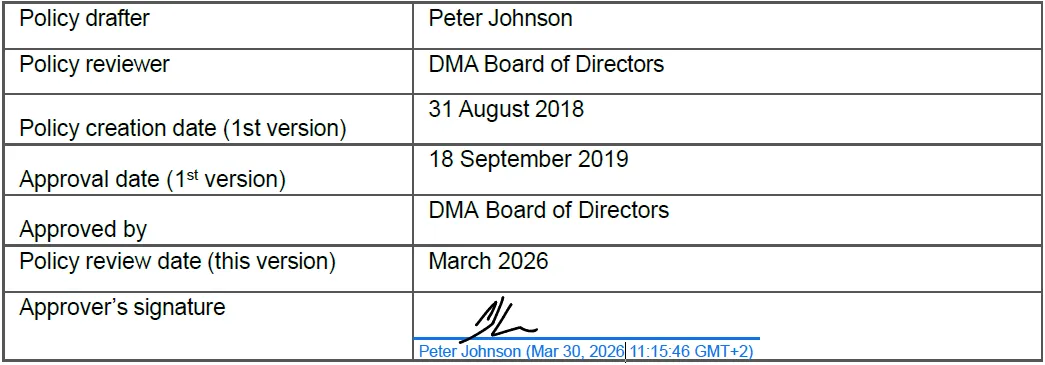
1. Policy approval and information
2. Introduction
2.1 SCM DMA (Pty) Ltd, its subsidiaries and affiliated entities (“DMA”), are obliged to act with due care and skill and in their clients’ best interests. This includes numerous statutory conduct stage disclosures which include Conflict of Interest. It is not intended to create third party rights or duties that would not already exist if the Policy had not been made available and it does not form part of any contract between DMA and any client or prospective client.
2.2 This Policy is a supplement to DMA’s overall general obligation to act with integrity and fairness, both
towards its clients and its counterparties, by providing:
- measures for identifying conflicts of interest;
- measures to manage and avoid conflicts of interest;
- measures for disclosing conflicts of interest;
- processes, procedures and internal controls to facilitate compliance with the Policy; and
- consequences of non-compliance with the Policy.
2.3 This Policy should be read and understood by all employees.
2.4 DMA is committed to professionally managing potential conflicts of interest which may arise between its constituent businesses.
2.5 This Policy is available to DMA’s clients upon request and is also made available on our website: www.dma.co. DMA reserves the right to amend or supplement this Policy at any time.
2.6 Heads of the different business sections in DMA are responsible for identifying, preventing and managing conflicts of interests in their section.
3 . Licensing conditions
3.1 According to the applicable Licensing Conditions applicable to DMA, as well as normal principles of good governance and Treating Customer’s Fairly (also refer to Treating Customers Fairly Policy), DMA shall develop written procedures for resolving conflicts of interest (to be approved by the Board), produce and disclose a list to clients of all related parties relevant to transactions where there are potential Conflicts of Interests, and maintain written record of all related party transactions which should include an explanation as to how the company reached its decision and conducted the transactions on an arm’s length basis.
3.2 A conflict of Interest means any situation in which a Licensee or a representative has an actual or potential interest that may, in rendering a financial service to a client:
3.2.1 influence the objective exercise of his, her or its obligations to a client; or
3.2.2 prevent a provider or representative from rendering an unbiased and fair financial service, or from acting in the interests of that client; including but not limited to:
- a financial interest;
- an ownership interest;
- any relationship with a third party.
3.3 It is important that all employees understand the meaning of 3.1.2 above. Please take the time to read the definitions which are explained below:
3.3.1 “Financial Interest” means any cash, cash equivalent, voucher, gift, service, advantage, benefit, discount, domestic or foreign travel, hospitality, accommodation, sponsorship, other incentive or value consideration, other than –
- an ownership interest;
- training, that is not exclusively available to a selected group of providers or representatives, on
- products and legal matters relating to those products;
- general financial and industry information;
- specialised technological systems of a third party necessary for the rendering of a financial service; but excluding travel and accommodation associated with that training.
3.3.2 “Immaterial Financial Interest” means any Financial Interest with a determinable monetary value, the aggregate of which does not exceed R1500 in any calendar year from the same third party in that calendar year, received by –
- a provider who is a sole proprietor; or
- a representative for that representative’s direct benefit;
- a provider, who for its benefit or that of some or all of its representatives, aggregates the immaterial financial interest paid to its representatives.
3.3.3 “Ownership Interest” means –
- any equity or ownership interest, for which fair value was paid by the owner at the time of the acquisition, other than equity or a proprietary interest held as an approved nominee on behalf of another person; and
- includes any dividend, profit share or similar benefit derived from that equity or ownership interest.
4. Examples of conflicts of interest
The definition of a conflict of interest is very broad and can cover a variety of situations. Therefore, it is useful to provide examples of potential conflicts of interest that could occur within DMA:
4.1. Employees are remunerated or have a component of their remuneration:
- where the financial interest is determined with reference to the quantity of business secured for DMA, without giving due regard to the delivery of fair outcomes for clients;
- which gives preference to a specific product supplier, where a representative may recommend more than one product supplier to a client; or
- which gives preference to a specific financial product of a product supplier, where a representative may recommend more than one financial product of that product supplier to a client.
4.2. A financial, or other, incentive that favours the interests of one client over another.
4.3. Market structures lead to conflicts of interest, especially around remuneration and outsourcing. Complicated relationships compromise accountability between product suppliers and intermediaries, often leaving the client unclear on the true cost of advice and on who the intermediary represents.
4.4. If a board member, who is in a position of trust, has a competing professional, or personal, interest, may make it difficult to fulfil their duties impartially. A conflict of interest exists even if no unethical, or improper, act results. A conflict of interest may create an appearance of impropriety, which may undermine confidence in the person, the activity, and DMA. A conflict of interest may impair a person’s ability to perform their duties and responsibilities objectively.
4.5. Employing relatives within the same entity, especially within a related department, may increase the potential for conflicts of interest (either actual, or potential). Potential conflicts may arise, due to nepotism, the carry-over of personal conflict into the workplace, favouritism, effects on employee morale. Therefore, this is discouraged within DMA.
4.6. Employees transacting in their business capacity, to the benefit of their personal share portfolio (also refer to the Personal Account Trading Policy).
4.7. Employees making business transaction decisions that are in contradiction to trading decisions that they are making on their personal share portfolios (also refer to the Personal Account Trading Policy).
4.8. Employees inadvertently becoming “insiders”, by being privy to material non-public or price sensitive, information, during their interaction with third parties (also refer to the Personal Account Trading Policy).
4.9. Employees have outside business interests that compete with or provide similar services to DMA.
4.10. DMA, an associate, department, or employee, realises a financial gain, at the expense of a client(s).
4.11. The interests of DMA, an associate, department, or employees, may be different to those of a client(s).
4.12. DMA, an associate, or employees, exercise the same professional activity as a client(s).
4.13. DMA, an associate, department, or employees, gain an advantage (whether financial, or not) from a third party, during the execution of the service conducted on behalf of a client(s).
4.14. DMA, an associate, or its representatives, using discretion to provide financial services to clients, may invest into associates, its own financial products, or financial products of its associates.
4.15. Commission, or fee sharing, arrangements, and broker allocation.
5. Identification and general disclosure of the nature of potential conflicts of interest and of their sources
5.1 DMA hereby identifies and discloses a range of circumstances which may give rise to a conflict of interest that may potentially but not necessarily be detrimental to the interests of one or more clients. Such a conflict of interest may arise if DMA, or any person directly or indirectly controlled by DMA or a client, is likely to make a financial gain, or avoid a financial loss, at the expense of a client. DMA will manage conflicts of interest fairly.
5.2 DMA has identified the following circumstances which may give rise to a conflict of interest:
- DMA many have an interest that is contrary to clients’ transactions, e.g. when clients trade in markets where DMA acts as a market maker or when DMA wishes to invest in the same instrument as the client;
- DMA, its employees and related legal persons may have, establish, change or cease to have positions in securities, foreign exchange or other financial instruments covered by an investment report;
- DMA’s sales traders may trade in securities or other financial instruments on behalf of the clients knowing that the trades will be beneficial to DMA’s, its employees’ or related persons’ positions in the same instruments;
- DMA may have an interest in maximizing trading volumes in order to increase its commission revenue, which is inconsistent with the client’s personal objective of minimizing transaction costs;
- DMA’s bonus scheme may award its employees based on the trading volume etc.;
- DMA may receive or pay inducements to or from third parties due to the referral of new clients or clients’ trading.
- DMA, it’s employees, and related legal persons may have interests in business competing with DMA’s clients.
6. Registration of conflicts of interest
DMA maintains a register of the investment services and activities and ancillary services carried out by or
on behalf of DMA which have given or could give rise to a conflict of interest, which may be detrimental to
the interests of one or more clients. The information in the register facilitates the management of conflicts
of interests and potential conflicts of interest.
7. Managing conflicts of interest
7.1 In order to manage possible conflicts of interest, DMA maintains processes, procedures and organizational arrangements, which are referred to hereinafter.
7.2 Critical arrangements of DMA’s Policy for managing conflicts of interest include the following:
- DMA aims at distributing third party research publications to clients, prospective clients and other third persons from time to time for information and educational purposes only, and in circumstances in which DMA will not reasonably be expected to have a material influence on a client’s or a third person’s investment decision;
- All employees are bound by professional secrecy and confidential information is only to be shared if essential for performing a job function;
- All employees are at all times bound to act loyally to DMA and be in full compliance with its procedures;
- All employees receive instructions and guidance regarding managing of conflicts of interest;
- All clients are to be treated fairly;
- Research publications are internally distributed exclusively at the same time as they are distributed to clients;
- All employees are bound by DMA’s rules and guidelines for employee trading as in force and effect from time to time;
- DMA’s bonus scheme is composed of several elements and each trade related element does not alone affect the bonus significantly;
- All representatives of DMA hold a license if a license is required for performing the business in the country where the representative is registered;
- DMA monitors internal reporting and the effectiveness of its policies and procedures for managing conflicts of interest.
- All employees are obliged to immediately inform DMA of any interests the employee or the employee’s related legal persons may have in any business competing with DMA or DMA’s clients and which could give rise to a potential conflict of interest.
8. Disclosure of conflicts of interest
If the measures in place are not sufficient to avoid or manage a conflict of interest relating to a client, DMA will disclose the conflict of interest before undertaking further business with the client.
9. Documentation and record keeping
9.1 For any conflict arrangements to be deemed adequate, they need to be documented. DMA has a written conflict management policy with the aim of handling of Conflict of Interest. All records of the following should be kept, for a period of 5 years:
- conflicts identified and actions taken;
- any reports given to DMA’s senior management about matters relating to conflicts;
- copies of written conflicts of interest disclosures given to clients.
10. Consequences of non-compliance with the policy
10.1 All employees are obliged to comply with the Policy, and it is a condition of employment. Non-compliance is a breach of their employment contract, and is an action of misconduct, so employees may be subject to disciplinary action, which may lead to dismissal. The human resources department will be approached about the disciplinary action process, to ensure that the process is followed in the prescribed way. For non-compliance with the Policy, reports made by the compliance officers, internal audit, external audit, and regulators, will be considered, for appropriate action to be taken.
10.2 Avoidance, circumvention, or limitation, of the Policy, will be deemed to be non-compliance.
Review
This Policy is reviewed on a regular basis and updated whenever necessary.
This policy is effective and shall remain effective until a more recent version is released. The prevailing version of the policy is always available at www.DMA.co/en-za / www.DMA.co/en-mu.